

Seven Keys to Improve Out-of-Network Collections

Reimbursement in out-of-network care has grown to $60B and continues to grow due to the proliferation of narrow networks. Many providers don’t play in the out-of-network space or write-off a big chunk of revenue to close out an aging A/R. So what does an organization need to do in order to maximize reimbursement in this arena?

According to Richa Singh of Collection Rx, 5-10% of healthcare revenue is lost due to lack of time and technology associated with the work involved to follow up on the cost of collections resulting from unprocessed claims, missing documents, and denials. In many instances, providers overlook claims that are not properly processed and, as such, miss out on revenue. More importantly, almost 40% of that revenue loss is in individual out-of-network claims, mostly due to inexperience with these types of claims as a result of no data with the payers and no time or staff to commit to understanding their rules let alone track down the revenue.

Many providers don’t play in the out-of-network space or write-off a big chunk of revenue to close out an aging A/R. Yet with so many stringent rules for in-network, the biggest revenue growth opportunity exists in out-of-network care! So what does an organization need to do in order to maximize reimbursement in this arena?

1. Understand Payer Tactics

Payers, unfortunately, have cost containment practices on what they consider unnecessary tests or treatments. When these services or payment are not contracted or clearly understood, providers miss out. You need to:

• Know a payer’s out-of-network payment trends and policies
• Have access to the data to prove a payer’s inadequate reimbursement
• Be persistent
• Dedicate the right resources with your efforts

Getting ahead of these roadblocks with technology to support your efforts of clean claims, maintain proper documentation, provide medical necessity, show submission of claims, and decipher EOBs will help increase out-of-network reimbursement.

2. Invest in Technology

Data and automated workflow rules will help improve your overall reimbursement rates and ensure you get paid for your services. Areas of suggestion include:

Workflow – Automate manual processes as much as possible
Data – Analyze data and comparable claims to understand payer trends
Coding – Supports workflow optimization to lower collection costs
Analytics – Deep dive into your metrics for strategic planning

3. Maintain In-depth Reconciliation Process Through Collections

Avoid missed revenue with automated workflow and checks and balances throughout the collection process.

4. Streamline Your Workflow

Identify weak links in the front-end of your A/R to avoid issues on the back-end, improving staff time management and reducing the cost to collect.

5. Gain Expertise in Out-of-Network Benefits/Payments

Drive business decisions by having access to actionable data that will allow analysis, such as root cause identification on underpayments and denials, and help identify trends, projections, and revenue impact on a weekly, monthly and even ad hoc basis to help improve financial performance.

6. Gain Out-of-Network Expertise

With a growing market of unrestricted contracts in out-of-network, there is an untapped opportunity to increase reimbursement rates and impact your bottom line. You need to know the trends and tendencies of out-of-network payments, have comparable data to counter tactics, and understand those tactics.

7. Outsource Payer Collection Efforts

Ensure your partner is provider-centric in that it is providing access to your collection data, helping you with reporting and understanding metrics of importance, and offering frequent success and troubleshooting reviews.

8. Enhance Patient Experience

Pricing transparency has been shown to improve collection efforts for self-pay patients. When a patient is aware of their financial expectations sooner, labs and the ordering physicians can avoid the run-around that often results from “surprise bills.”

Quadax specializes in helping healthcare providers maximize reimbursement – both in- and out- of-network – through billing and software solutions geared to solve the challenges associated with navigating the payer landscape to help expedite claims and payment processing. Want to learn more? Let’s talk!

Content adapted from Strategies for Success in Out-of-Network and Payer Reimbursement, May 2019.
https://www.beckershospitalreview.com

Is Your Lab Applicable Under the New PAMA Definition?

PAMA has already made a significant impact for hospital and independent labs, and continues to do so with the redefinition of an applicable lab. PAMA has expanded the number of reporting labs to include smaller labs and hospital outreach labs. CMS estimates at least 43% more labs are now required to report under the new definition. Therefore, labs not reporting during the first period need to double check their requirement.

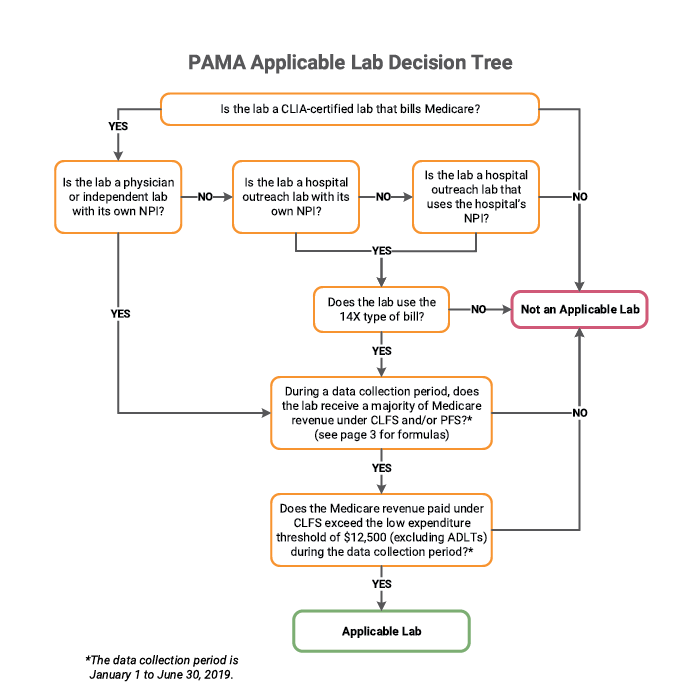
As defined by CMS, an applicable lab is a laboratory receiving more than 50% of its total Medicare revenues from services paid under the CLFS or the physician fee schedule (PFS), with a low expenditure threshold. To meet the low expenditure threshold, a lab must have received $12,500 from final Medicare paid claims for services paid under the CLFS during the data collection period of January 1 to June 30, 2019.

A new wrinkle per the 2019 Final Rule is that Medicare Advantage revenues are excluded from the total Medicare revenue calculation.  The change for round 2 that may have the greatest impact is that hospital outreach laboratories billing “non-patients” for laboratory services are now included in the applicable lab determination.

In Transmittal 3425, a non-patient is defined as a beneficiary who has a specimen that is submitted to a hospital for analysis but is not physically present at the hospital for the laboratory service; that is, the patient is neither a registered hospital outpatient nor an admitted hospital inpatient. Non-patients may be identified with the CMS-1450 14X TOB.  An inherent challenge is that the 14X bill type is not necessarily used by commercial payers.  This seemingly small modification will have significant impact to which organizations are considered “applicable labs” and to the algorithms by which providers select data for reporting.

Labs meeting these qualifications must then report “applicable information” to CMS. As a service to our clients, Quadax has developed the PAMA Applicable Lab Decision Tree shown below, which visually depicts the determination criteria.

Applicable_Lab_Decision_Tree


Quadax financial reporting quickly and accurately provides the data needed to walk through this process and determine a lab’s status under PAMA.  Quadax supports laboratories with tools to meet all regulatory requirements touching the revenue cycle. In addition to equipping labs with tools to help them identify their PAMA applicable lab status, Quadax makes it easy for applicable labs to select and segregate the correct, complete data required for submission.

To learn more, join us during this complimentary webinar, PAMA Tools & Strategies for The Next Round of Reporting on June 26, 2019 at 11:00 AM EDT.

This webinar will provide further insight into the strategies and tools successful labs use to determine applicable lab status, capture the appropriate claims population, and supply and normalize data to meet PAMA Reporting guidelines.

Register for Webinar

Patient Access Antidote: How Labs Can Retain More Revenue

Patients’ financial liability in paying for healthcare services is almost unrecognizable from that prior to the early 2000s; yet many organizations, including clinical laboratories, have struggled to modernize their collection practices in turn. As a result of this mismatch, labs risk not just losing out on uncollected revenue, but also wasting time and resources on futile or minimally effective back-end collection efforts.

Reversing the problem is possible, however, by implementing the right best practices and revenue cycle management technologies. In particular, maximizing patient access early in the revenue cycle can help patients manage their financial responsibility and preempt many unnecessary denials, payment delays, and uncollected balances.

In this Dark Daily white paper – Patient Access Antidote: Retaining More Revenue with Front-End Solutions – take a deeper dive into the consumer trends having an impact on revenue cycle management, best practices in patient access management, and the expert-recommended tools and solutions that clinical laboratories can employ to respond.

We are also presenting on Patient Access topics at the 24th Annual Executive War College. If you are attending, don’t miss these opportunities to learn new strategies to help your lab sustain financial stability and growth. {Quadax is proud to be a Benefactor Sponsor of this annual conference.}


Tuesday, April 30 | 8:30 a.m. Brean Bark
Director, Product Development 
Missy Tubbs
Senior Product Manager
Patient Responsibility & Payer Pre Billing Requirement Impacting Your Bottom Line?
Engage Physicians and Patients with Patient Access Solutions & Analytics To Improve Revenue.

Wednesday, May 1 | 7:30 a.m. Walt Williams
Director of Revenue Optimization
and Strategy
Are Your Patients Now Your Payers? New Tools Empowering Your Lab to Collect More Money, Faster, and at Less Cost.


At Quadax we take on your billing needs so you can do more to improve the delivery of value-based care and transform patient outcomes. Explore our revenue cycle optimization solutions to expedite payment, maximize reimbursement, and enhance visibility into your business. Get in touch with our RCO team and discover how we can help you create areas of opportunity to achieve the best possible revenue outcome.

Pursue LDT Revenue Cycle Success with Cross-functional Collaboration

In many traditional lab organizations, the scientific product development group has historically produced new diagnostic tests without meaningful input and consideration of payer policy and revenue cycle demands. But what if the lab were to begin considering the needs of the revenue cycle even earlier? What if revenue cycle considerations were included in the lab’s decision-making about test development and commercialization? How could collaboration between the lab and its revenue cycle group help improve financial performance?  Labs who integrate revenue cycle management considerations into new test development have a higher chance of reimbursement success and achieving profitability.


Bringing the revenue cycle and the lab together.

Labs who consider revenue cycle issues at all stages from the beginning of the test development through deployment and billing, are able to gain synergies and successfully implement a cohesive commercialization strategy. Collaboration between sales, marketing, laboratory personnel, and other stakeholders is key, especially for lab’s developing and launching novel diagnostic tests. When information flows both ways, the development team provides the necessary information to help the financial team make revenue and volume forecasts that are more realistic. Conversely, feedback to the lab that considers the existing medical payer policy environment, clinical utility guidelines, and revenue cycle demands can potentially lead to development of more commercially viable tests.


How the lab benefits from collaboration.

Scientific advisors of the laboratory have expertise in a molecular testing technology, modality, or other unmet healthcare needs that would lend itself to development of a new test. Many laboratories spend their R&D budget on new assay development without fully understanding the reimbursement environment for the test they are developing. Early revenue projections may be overly optimistic, and may not account for limited payer coverage for the test.

A new test that may prove “popular” with clinicians may bring in a large volume of business, but if reimbursement rates are low or result in greater patient cost-share, the financials of that test may not be beneficial to the lab. The ability to identify which tests, patient populations, providers, and payers perform best financially, and which do not, can help guide the laboratory in test development decisions. With a cross-functional team—commercial, marketing, revenue cycle, finance, and payer relations/market access—input from both lab management and those responsible for financial operations can influence R&D direction.


How the revenue cycle benefits from collaboration.

Marketing and sales teams must differentiate a lab’s new test from other treatment options, so that physicians will deem it clinically necessary for their patients. Communications need to be developed to inform physicians, patients, and payers as to the use and benefits of the new test.

When the lab comes together with its revenue cycle during test development, the cross-functional team can methodically address the following questions and capture the necessary data needed for commercialization communications. If the payer will not pay for the test, what evidence must be developed to secure positive coverage and what is the timeline for developing such evidence? What is the marketing message and will it need to include specific intended use guidelines? What pre-test requirements (e.g. medical policies, prior authorization) will exist for the test? What is the appeal strategy? What is the patient billing strategy? What is the institutional/client billing strategy?


When cross-functional collaboration is limited or lacking, what are the associated risks?

If different teams within a lab are not collaborating, the unintended consequences can be high costs and minimal revenue. Demonstrating clinical relevance can suffer, and insurance companies may choose to either not cover the test or cover it with many restrictions and with sub-optimal reimbursement.

When collaboration is lacking or limited, objectives within the lab may become misaligned. Sales might offer resistance to billing and finance, trying to balance gaining market traction and order volume against accepting samples that may not meet the clinical criteria for reimbursement. Investors and senior management may focus too early on driving revenue, versus evidence development. In its pursuit of growth and volume, the laboratory’s organization may hire a large sales team to drive utilization well before the evidence is ready to support broad coverage and reimbursement.


Building cross-functional collaboration to manage these risks.

What are the challenges a lab will face when bringing new diagnostic tests to market and what can a lab do to circumvent these challenges to achieve its financial goals? View our Cross-functional Collaboration Is Key to Diagnostic Test Commercialization whitepaper to learn more about what your laboratory can do to make your LDT a revenue cycle success.

Quadax understands the issues and industry challenges facing your lab today. We partner with our clients to provide a complete revenue cycle solution—with expertise focused on patient access; claims, reimbursement, denials and appeals management; and business analytics we offer a lab-centric revenue cycle solution. To learn more about how Quadax can help, view our revenue cycle optimization solutions.

14 Day Rule Regarding ADLT and MolPath Tests Continues to Show Movement

Movement continues on CMS reimbursement of Advanced Diagnostic Laboratory Tests (ADLTs) and Molecular Pathology testing during the 14 days following a hospital stay.

Recently it was announced that CMS will exercise enforcement discretion until January 2, 2019, for the laboratory date of service (DOS) exception policy for ADLTs and molecular pathology tests excluded from Hospital Outpatient Prospective Payment System (OPPS) packaging policy.

If you are a performing laboratory prepared to bill Medicare directly for ADLTs and molecular pathology tests subject to the new laboratory DOS exception, this enforcement discretion period does not prevent you from doing so before January 2, 2019. However, in no case should both the hospital and the performing laboratory bill for the same test for the same beneficiary.

Labs that have billed tests under the DOS exception and experienced denials, including where Medicare is secondary, may want to contact their Medicare Administrative Contractor (MAC) for further direction on these claims.

The policy may be found here.

For a brief overview of the Medicare Hospital Outpatient Prospective Payment System (OPPS) and revisions for 2018, you can check out this blog post.

Prior Authorization – The Lab’s Dilemma

How are some of the payers’ Prior Authorization (PA) programs impacting your laboratory’s bottom line and what can you do about it? Increasingly, retroactive authorization after performing lab tests is becoming a less viable option; as is fighting denials for lack of Prior Authorization during the appeal process. While some payers still allow retroactive authorization, in general, laboratories who test specimens without prior authorization run the risk of performing uncompensated testing.

Quadax, a long-standing provider of Revenue Cycle services for the laboratory market, explored Anthem’s and United Healthcare’s prior authorization management programs’ real impact on: claims processing timelines, receipts, payment timeliness, denial trends, and more. Our data driven analysis focused on the variance before and after implementation  revealed the following:

Overall, denials have increased since program implementation, UHC denials increased 49% and Anthem 22%.  Testing for inheritable genetic disorders is being hit the hardest by these programs. Perhaps due to increased scrutiny, these tests are experiencing the highest increase in denials. For some CPT codes, denials have increased by over 70%.

When a lab test required a PA by the payer, denials increased substantially when claims were filed without prior authorization. Since program implementation, 85% of claims submitted to UHC without the required PA have been denied. The chance of being paid by Anthem is slightly better, as 66% of claims submitted without PA have been denied. Even when prior authorization is filed appropriately, the claim may still be denied (45% of the time by UHC and 29% by Anthem).

When labs successfully navigated payer requirements and the payer program processing, overall payment turnaround time was faster (UHC 26%; Anthem 13%).

Attempting to overturn a denial using an appeal process has been less successful since program implementation and resulted in fewer dollars. The appeal allowable contribution after initial denial for no PA was substantially decreased by 40% at Anthem (UHC – too soon to tell). Regardless of how robust a lab’s appeals process might be, the numbers are showing diminishing returns since program implementation. Labs may no longer be able to “make it up” in the appeal process after having missed payer prior authorization requirements.

 Quadax continues to investigate these trends on behalf of our laboratory clients. Our findings suggest that laboratories need to re-evaluate their prior authorization strategy. As recent as early last year, retroactive authorization was a normal operating procedure – a lab would accession the specimen and go right to testing. At that time, the lab would begin their revenue cycle starting with benefit investigation. In today’s environment, this process exposes the lab to the full cost of acquiring the specimen, transporting the specimen, all of the consumables, and the cost of the lab kit while offering no guarantee of payment. If the payer’s Date of Service (DOS) rules dictate using the specimen collected date, similar to Medicare and Medicaid, any attempt by the lab’s staff to obtain PA is considered a “retro” authorization. When a payer no longer allows retro authorization and prior authorization was not done by the ordering physician, data shows that the lab stands to have a diminished chance of getting any reimbursement.

In response, some labs have moved prior authorization discovery to earlier in the process, some handling it at the same time as accessioning. The lab’s staff starts to work with the referring physician earlier, prior to testing, to acquire the necessary authorization. At this point the lab still has the physician’s attention. Wanting and waiting for the test results, physicians may be more attentive to lab requests for medical necessity documentation. By not immediately performing the test, the lab can avoid the cost of processing the specimen until they have acquired payer authorization. However, this does not resolve the fact that the lab is still forced to request the authorization in a “retro” state if date of service is collection date and the physician has not started PA. More importantly, current Anthem and UHC policies require the ordering provider to initiate Prior Authorization. If testing is delayed specimen stability may become a concern and, from the stand point of personalize medicine, delays can have a negative impact on the patient’s clinical care. This is an unintended consequence of these burdensome programs that payers have put into place.

It is ideal to perform the prior authorization at the time of, or before ordering the test (during the patient’s visit with the physician)—before the patient goes for specimen collection. However, this process increases the administrative burden for the ordering physician. Many laboratories lack the necessary patient access management (PAM) tools on the front end to help ease the ordering physician’s burden and navigate the payer prior authorization programs successfully, or even be aware that prior authorization is required.  One of the greatest challenges standing in the way of PA is that physicians are used to ordering procedures for their patients through their respective EMR systems. However, many EMR systems lack the ability to manage the constantly evolving lab requirements and/or accommodate the lab’s needed data. Physicians are inundated with a variety of online portals already and having them log into one more portal just adds to the growing “portal fatigue” physicians already experience. This creates another burden for the lab to manage.

In the wake of these reimbursement complexities, the new programs originally intended to promote appropriate, cost-effective healthcare may be preventing access to critical laboratory services used in the prevention, diagnosis, and monitoring of disease.

By developing a set of prior authorization tenets, the American Clinical Laboratory Association (ACLA) seeks to improve the payer processes that have begun to pose serious risk to patient care, and minimize the delays in laboratory testing and negative impacts created from such processes. The traction these tenets do or do not get with payers, will be something to watch for.

What can your lab do to navigate changing prior authorization requirements? Explore your options. Walt Williams, Director of Revenue Optimization and Strategy at Quadax, presents his new webinar, Implementing a Prior Auth Program: Choosing the Right Strategy for Your Lab on Thursday, July 19 at 2:00 p.m. EST. Quadax is proud to be your guide with 45 years of experience successfully navigating healthcare change.

Accelerate Receivables: Monitor KPIs for A/R Search and Rescue

Is your cash stranded in the vastness of your lab’s accounts receivable (A/R)? Targeted revenue search and rescue efforts can improve your lab’s financial performance. Know where to send the search party—monitor key performance indicators (KPIs) Days in A/R and Aged A/R.

Representing many of the most prominent laboratories in the diagnostic market space, Quadax solves cash flow issues surrounding aged A/R. We advise clients and provide the resources to closely monitor revenue cycle performance which starts with analyzing the aged accounts receivable.

When performance is measured, performance improves.

Where metrics measure data, KPIs relate and compare metrics to measure performance and track progress toward achieving a lab’s financial objectives. Calculated on a regulated, recurring basis, often from month-to-month, KPIs compare and contrast current to historic values to identify underperforming areas, anomalies, and trends. Management can then investigate and determine what action should be taken to achieve performance targets.

Defining performance – good, better, and BEST.

Charting your lab’s revenue cycle course and direction, consider goal setting that recognizes multiple levels of performance—good, better, and best. In addition to meeting baseline targets, aim to exceed expectations with “stretch” goals that move the needle. Mining historic data to establish past norms, create growth goals that model your financial expectations.

Translate reimbursement performance goals into KPI targets. Communicate targets as a range, a discrete number, or use a directional trend for those targets that are based on estimates. The more clearly defined the targets, the easier it will be to measure and rate performance.

KPI Best Practices

A KPI’s reliability is directly related to how it is calculated, what data is used in its calculation, and how its results are interpreted. Once you determine what KPIs you will monitor, it is best to use the same calculation from week-to-week, month-to-month so performance is consistently measured. Also consider using exclusive data groups that can provide insight into the performance of your lab’s payer strategies (in- and out-of-network) and test service technology platforms. If the data is too far reaching, it may contain outliers that can hide underperformance. When investigating KPI results that are out-of-target, you may want to reference historic trends as a basis for assigning significance and impact. For the most reliable performance tracking, it is best to monitor a balanced scorecard of several different KPIs, providing various views into your lab’s revenue cycle performance. Need help building your lab’s KPI Scorecard? Contact us for a list of recommended KPIs.

How to Monitor Your Lab’s Receivables

To measure your lab’s A/R performance, monitor Days in A/R and Aged A/R. Consider the following:

How many days of sales are sitting in accounts receivable? Determining the average number of days it takes to collect payment on services rendered, Days in A/R measures the rate of A/R turnover. Also referred to as Days Sales Outstanding, Days in A/R can project payer turnaround time (TAT). Computed by payer and test, a laboratory can compare TATs and target areas of underperformance. Although there are multiple formulas, it is most commonly calculated as Net A/R divided by Average Daily Net Revenue. When calculating Days in A/R, consider any seasonality within your sales cycles and select a time period for computing Average Daily Net Revenue that minimizes impact—once selected, use it consistently over time.

Analyzing my lab’s A/R, what payers and which products are not clearing A/R in a reasonable amount of timeA trending indicator of receivable aging and collectability, Aged A/R can measure your lab’s ability to get services paid in a timely manner. Depending on your mix of test types and payers, KPI may target % of A/R > 90 or % of A/R > 120. Showing the distribution of open A/R across 30-day aging buckets, Aged A/R is most commonly presented as a series of percentages where each percent is calculated as the Net A/R summary for each aging bucket divided by the total Net A/R. This allows for early detection as A/R ages and shifts to the older buckets, allowing the lab to target operations and claims follow-up efforts. When setting up these calculations, consider which start date will be used in determining a claim’s age – date of service or date billed. This consideration is particularly relevant as it applies to secondary and tertiary claims. Will your lab re-age the claim restarting with the secondary bill date or will it continue to track aging from the original date of service?

Next steps… Continuous Improvement

As performance tools, KPIs monitor revenue cycle patterns and trends to detect changes, quantify variance, and target investigation. Laboratory management assigns significance, first, by setting performance targets, and second, by investigating when targets aren’t met. KPIs may not be silver bullets, but they can aim your revenue search and rescue efforts.  As you monitor performance, update targets, and refine financial expectations, learn how our lab-centric revenue cycle solution can provide you the quality data-driven analytics you need. Check back for future blog segments on measuring and tracking reimbursement performance.