
FASB New Standard on Revenue Recognition – Are You Ready for ASC 606?

With effective dates looming, ASC 606 implementation readiness is top of list for many executives. All entities that enter into contracts with customers will need to be prepared. Effective dates are set to begin after December 15, 2017 for public entities and after December 15, 2018 for nonpublic entities. The intent of the new Accounting Standards Update (ASU) No. 2014-09 is to establish a core principle for revenue recognition across all industries, both domestically and internationally, with converged guidance from the Financial Accounting Standards Board (FASB) and the International Accounting Standards Board (IASB).

Revenue, as a measure of performance, is used in comparative analysis, risk assessment, and other business venture due diligence. By making revenue recognition consistent, the new standards will help users of financial statements understand the nature, amount, timing, and uncertainty of revenue and cash flows arising from contracts with customers.

Health care providers should understand not only what rules are changing, but also how the updated standards may impact financial modeling and reporting. Detailed attention should be given to the rules’ impact on net patient service revenue given the variety of contractual arrangements present in this revenue stream. For help understanding ASC 606 unique impact on healthcare, The American Institute of CPAs (AICPA) Health care Entities Revenue Recognition Task Force is one of 16 industry task forces created to identify potential implementation issues and provide guidance.

By way of an overview of the New Standard on Revenue Recognition, please reference FASB ASC Topic 606 Fast Facts below. Another excellent resource for Healthcare Financial Management Association members is the article, Healthcare Revenue Recognition 5 Steps for Net Revenue Modeling and Reporting Considerations, published January 2017.

FASB ASC Topic 606 FAST FACTS
Who All entities that enter into contracts with customers.
What Financial Accounting Standards Board (FASB) New Standard on Revenue Recognition

Accounting Standards Codification (ASC) Topic 606 (ASU 2014-09): Revenue from Contracts with Customers

Core principle: recognize revenue to depict the transfer of promised goods or services to customers in an amount that reflects the consideration to which the entity expects to be entitled in exchange for those goods or services.

When On 8/12/15, FASB decided to defer the effective date by one year.

Public organizations should apply the new revenue standard to annual reporting periods beginning after December 15, 2017. Nonpublic organizations should apply the new revenue standard to annual reporting periods beginning after December 15, 2018.

Where To help identify WHERE implementation challenges may be greatest for healthcare providers, please visit AICPA’s Health Care Entities Revenue Recognition Task Force landing page for implementation issue updates and guidance.
Why Objective: Establish the principles to report useful information to users of financial statements about the nature, timing, and uncertainty of revenue from contracts with customers.
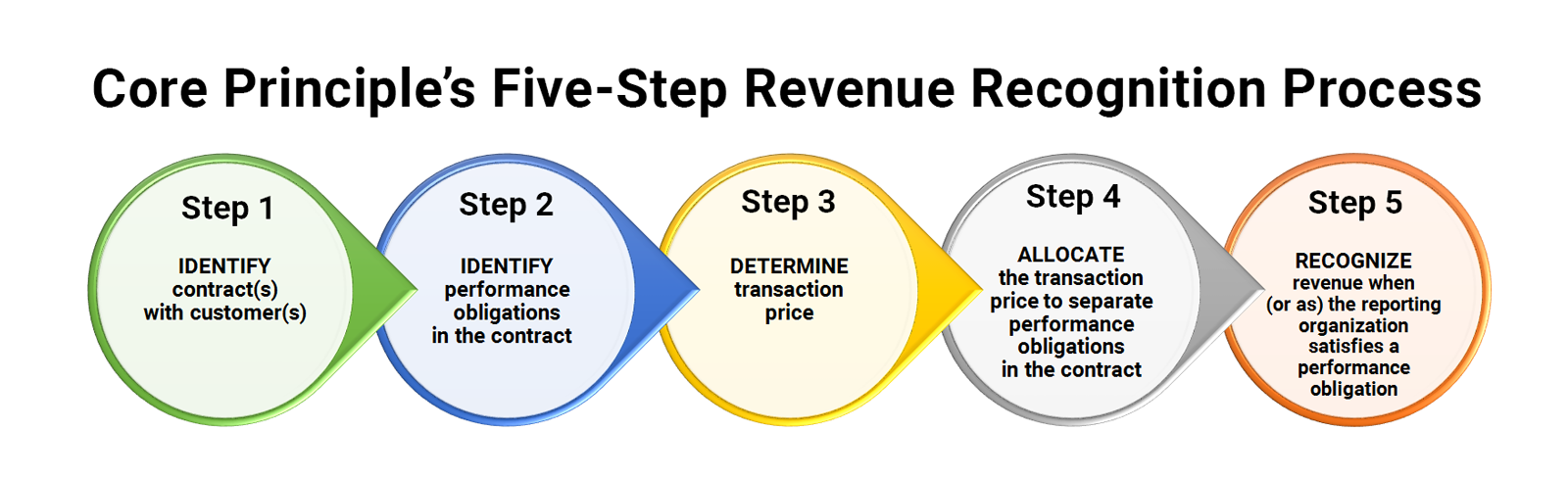
How FASB ASC Topic 606 outlines for organizations the five steps to use to determine HOW to recognize revenue from customers.

RR-Graph.png


Given healthcare’s variety of contractual arrangements with customers to provide services and goods (performance obligations), the numerous ways that entities are paid may make implementation a challenge. Add to that the industry’s transition to value-based reimbursement, and healthcare providers find themselves facing additional complexity when executing revenue recognition step #3, determining the transaction price.

Companies will need to choose which method they will use to comply with the new FASB standard. There are two transition methods: Full Retrospective and Modified Retrospective. Some companies may opt to restate sales for the required number of prior years, while other companies may choose the modified compliance approach, applying the new rules only to existing and future contracts as of the effective date. Regardless of which method chosen, a significant amount of dual reporting will be required—reporting both under the old Generally Accepted Accounting Principles (GAAP) and the new incorporating FASB ASC Topic 606.

Whether public or nonpublic, affected companies should begin preparing now for the adoption of the new requirements. Inventorying revenue streams—developing reporting formulas for every class or type of contract—and evaluating how revenue will be affected by the new rules is a great place start. ASC 606 countdown has begun!


Implications of Narrow Healthcare Networks on Laboratory Providers

In less than three short years (2014-2017), narrow and ultra-narrow networks have increased from 48% to 53% of all networks. With their majority influence, these networks are reshaping the healthcare industry. To survive, labs of all kinds will need to understand the implications of narrow healthcare networks on their ability to access patients and collect reimbursement.

To begin, it is important for laboratory managers and pathologists to understand the reasons behind insurers’ creation of narrow networks and their perceived value by consumers and employers.

How do plans with limited networks provide cost savings for health insurers and health consumers?

The goal is to deliver increased patient volume (and revenue) to the provider in return for lower costs to the insurer (and ultimately the patient) achieved through reduced rates. Insurers limit the number of doctors, hospitals, and other providers a patient can visit in order to negotiate a lower cost for services with networked providers in return for a higher volume of patients. Insurers also promote to consumers that narrow networks allow insurers to influence the delivery of coordinated healthcare by offering targeted in-network solutions to help physicians and providers give patients more personalized care.

Looking for value, consumers prefer health plans with lower premiums over higher-priced health plans that offer access to more providers—22% and 19% respectively. Similarly, employers prefer the benefit of lower health plan premiums with 56% of employers considering narrow networks as a way to reduce medical costs. The level of savings could be a very good deal for consumers and employers, but whether these health plans can deliver value depends on whether or not the insurer’s selected network can provide adequate care.

With limited accessibility and availability, can narrow networks provide adequate care?

While narrow network plans might save money for insurers, consumers, and employers, they could make it harder for patients to get the care they need, where and when they need it. The plans may not include enough nearby providers and the providers they do include may be too busy to take new patients in a timely fashion. This could be problematic if a patient is unable to obtain the timely healthcare they need within their network. It can be further compounded if the plan provides limited or no out-of-network benefits.

Network Adequacy Standards

Federal and state regulations qualitatively state that networks should provide for reasonable access, without unreasonable travel or delay. Regulation of health plan provider networks often includes quantitative standards that may review the number of providers, provider-to-enrollee ratios, the mix of provider types, and the distribution/location of providers from whom enrollees may reasonably be expected to obtain services. Encouraging network transparency, regulation may also require that provider directories are updated at least once each month. The key to any successful regulation is compliance and enforcement. Without means to measure and enforce Network Adequacy Standards proactively, federal and state regulators are limited to respond after-the-fact to patient complaints regarding network compliance.

Implications laboratory providers may want to consider

Whether your laboratory pursues an in-network or out-of-network strategy, it is important to consider the effect narrow provider networks will have on your lab’s ability to access patients and collect reimbursement.

  • If your lab is seeking to be an in-network provider in a limited network plan, it may be helpful to learn about the network’s size, mix, and distribution/location as well as any governing Network Adequacy Standards that may be in effect. This information can help you communicate how your lab will fit within and add value to the network’s model. Also, be prepared to discuss price. It may be helpful to approach the topic of price from a value-based perspective. Payers will be interested to learn how your lab testing services can contribute to improve patient outcomes and reduce the cost per episode of care. You may want to demonstrate your lab’s value by sharing relevant statistics. For additional network negotiation strategies, reference Developing Clinical Laboratory Strategies to Gain Network Access.
  • If your lab remains an out-of-network provider, your lab will need to balance offering a low price through the narrow health network with preparing for patients to be responsible for paying the entire cost of the test. Be aware that out-of-network providers face new constraints on their ability to balance bill members of government-funded and commercial plans, while commercial payers are continuing to sue out-of-network providers to stop improper referrals and cost-sharing waivers.

Regardless of your network strategy, it is important to know the implications of narrow healthcare networks on your lab’s business model and to have available your lab’s performance statistics so you can negotiate value and drive efficiency and cost containment measures. Learn how Quadax can help; visit Reveal Opportunities. Analyze Impact. Deliver Results.

How to Improve Payments as HDHPs Increase Patient Responsibility

Patient responsibility has always been a liability for providers. Unlike automated claims processing that submits electronic 837s to an established group of payers, the ability to collect on patient responsibility requires individual patient billing and often involves manual processing and time-intensive follow-up.

While the upfront dollar value of patient responsibility continues to increase across all plan types (HMO, PPO, POS, and HDHP) – now averaging $1,478 – the escalating adoption rate of high deductible health plans (HDHPs) means that a growing segment of the patient population is now responsible for greater payment amounts before insurance coverage begins. According to the Kaiser Family Foundation 2016 Employer Health Benefits Survey, 29% of covered workers are enrolled in an HDHP – up from 20% in 2014 – and the average HDHP deductible is $2,199.

As the financial liability shifts, the best way to reduce your exposure to uncompensated care is to expedite the collection of your patients’ responsibility—co-pay, co-insurance, and deductible.

Successfully collecting payment directly from the consumer rather than a payer may require a shift on the part of the provider: consider introducing a B2C payment processing model. Targeting patient payment processing solutions, both pre- and post-billing, this new B2C model should be patient-friendly and provide convenient and efficient automation with self-help payment options. The goal is to make it easy for patients to pay so you can collect patient payment as soon as possible.

Here are four steps you may want to consider.

1. Assist patients in making informed decisions.

Start by confirming your patient’s eligibility for the services to be rendered. While verifying your patient’s insurance and coverage, identify if there are any pre-claim requirements such as prior authorization and medical necessity documentation. Then calculate upfront your patient’s out-of-pocket cost, informing your patient of his/her responsibility. To learn more, visit A Smart Start to Your Revenue Cycle.

2. Collect patient payment information.

Think B2C. In addition to obtaining correct patient demographic information, consider gathering credit card information. Remember, HDHPs shoulder patients with a greater upfront cost burden. To get paid, providers need to be able to collect payment directly from the patient.

3. Make it easy for patients to pay.

Begin by communicating to patients easy-to-understand charges. Then offer convenient, accurate, secure B2C payment processing options—in today’s world, consumers expect online. In addition, consider offering payment plan options for select services. Smaller, easy-to-pay installments can help patients meet their responsibility. To learn more, visit Patient Responsibility Made Easy.

4. Coach your patient-facing staff.

Your patient-facing staff excels at helping patients with their healthcare needs. Now, coach your staff on how to help patients manage their payment responsibility. With assistance from your staff, your patients will come to understand their HDHPs and will learn to anticipate and know their responsibility in paying for healthcare services.

Most providers are already collecting a patient’s co-pay and co-insurance at time of service. With HDHPs, this model needs to be expanded to address a patient’s total out-of-pocket cost as it relates to the patient’s unpaid deductible. Finding ways to expedite your patient payments can help optimize your revenue cycle and accelerate your revenue cash flow.


4 Strategies for Molecular Diagnostic Labs to Maximize Reimbursement

At the forefront of innovative medical technologies, genetic laboratories are making breakthroughs in testing and treatment that confer significant benefit to patients. After overcoming regulatory hurdles to bring these procedures to market, however, the essential task of moving that test or treatment from unlisted to commercially reimbursable is a long road fraught with difficulties.